
The Bertrand family
What is the wine-making process?

Wine has existed since the dawn of time. So let us revisit its production process, and pause for a moment to appreciate its magic. Indeed, the elaboration of a wine involves a certain number of operations, at the optimum moment. Observing the vegetative cycle of the vine and human intervention contribute to enhancing the essence extracted from the terroir of each vine stock. For it is from a combination of viticultural and oenological knowledge that, once the grapes have reached their optimal ripeness, the smooth running of the production process comes into play. Close monitoring of the quality of the harvest, of vinification and of post-fermentation processes is decisive in obtaining, upon tasting, a clean wine with a beautiful aromatic complexity, typical of its terroir.
When it comes to winemaking, certain production steps for white, rosé and red wines are sometimes not followed in the same order. Moreover, certain white wines can be produced from red grapes, but here we will address the most common winemaking process.
Discover the high-end wine collection from the Gérard Bertrand estates
The harvest: the optimum date for picking
The quintessence of wine begins at the heart of the vines. As such, the date of the harvest is a determining factor. However, the quality of the grapes and optimal ripeness require an analysis of sugar indicators, pH and the acidity of the grape berries. Whether for white wines, red wines or rosé wines, the harvest date is decided through sampling and analysis of the grape variety berries.
Surveying the terroir to determine optimal ripeness
From the end of véraison, grape berries are sampled in order to monitor their development. It is by walking through the vine plots and observing the foliage, the soil, and by tasting the berries, skin, pulp and pips that the harvest date is determined. Indeed, this phytosanitary assessment of the harvest already outlines the future manipulations required for winemaking.
Discerning the right moment to decide on the harvest date
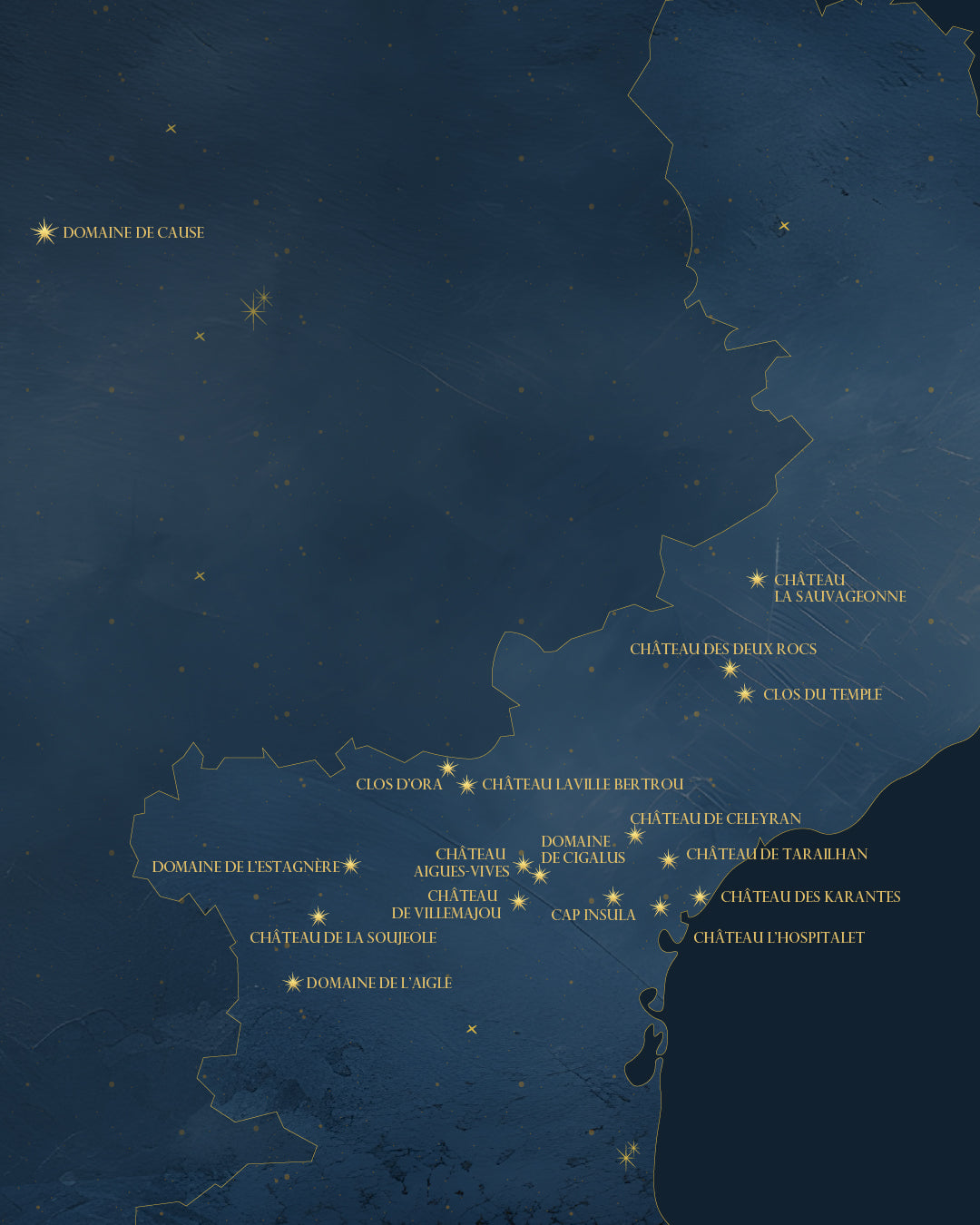
The vine is alive. Working it requires expertise and discernment. It is the vine that is at the origin of texture, flavours, aromas and sensations such as the assertiveness of the skin and the ripeness of the pips. On the same plot of vines, the same grape variety does not necessarily react with the same exuberance. As is the case at Gérard Bertrand with plots of Chardonnay, on the Domaine de l'Aigle Royal. The vines are exposed at over 500 metres altitude, trained in espalier, facing due south towards the mountains. They benefit from a mountain and Mediterranean climate. Certain vine stocks, in the same row, may ripen earlier than their neighbours depending on the vintage. This is why the phenolic ripeness of the grapes and the quality of the harvest are monitored using a refractometer. Thus, the sugar content of the grapes is measured, providing an approximation of the potential alcohol level.
Once the grapes have been harvested, in order to limit their oxidation, they are immediately transported to the winemaking cellar.
Destemming: for red grape varieties
Destemming and crushing mainly concern red grape varieties destined for skin maceration. Once destemmed, the grapes are freed from the stalk, which constitutes the woody part of the grape bunch. Thus, destemming is a delicate step requiring particular attention since the crushing of the grape berries must be limited. The winemaking process of Prima Nature Syrah includes destemming before its maceration phase.
Maceration: for better extraction
Vat maceration provides better extraction of the phenolic compounds from the grape, such as a more intense colour and more powerful aromas.
Pressing: before the start of fermentation for white wines
For the vinification of white wines, the grape berries are pressed before the start of fermentation. As is the case with the white grapes from Domaine de Villemajou. Upon their arrival at the winery, the Marsanne, Maccabeu, Bourboulenc and Roussanne grape varieties are pressed as gently as possible using a pneumatic press. Whereas for the production of red wines, pressing takes place after fermentation.
Alcoholic fermentation: rigorous daily monitoring in the vat room
When the winemaking process takes place under the best conditions. It is the yeasts naturally present in the environment and on the grape berries that convert the sugar in the grapes into alcohol and carbon dioxide. This process produces heat and develops aromatic compounds. This is why a rigorous daily monitoring of the densities of each vat is put in place using a mustimeter. At the start of fermentation, the first density readings taken from the juice are between 1,110 and 1,080. Then as it evolves, the specific gravity decreases to 994 or even 993, to complete the alcoholic fermentation.
Draining the vat: concludes the maceration of red wines
Draining the vat is an essential step in the winemaking process. It takes place just after alcoholic fermentation. It concludes the maceration of red wines. The juice from the vat is then transferred to another one. But it is still filled with decomposing skins, stalks and pips that must be removed manually using a pitchfork and a shovel. To be transferred to the press in order to be pressed and extract what is known as press wine. This operation is generally carried out by entering the vat. However, the production of a dangerous gas, carbon dioxide, is toxic, making this handling extremely perilous.
Alcoholic fermentation: rigorous daily monitoring in the vat room
Once alcoholic fermentation is complete, the dead yeasts leave a medium rich in alcohol, amino acids and nutrients. The lactic acid bacteria then convert malic acid into lactic acid. This creates notes of butter and hazelnut, influencing the organoleptic quality of the wines. Malolactic fermentation is always carried out for red wines. It is only for white wines that this phase can be inhibited by cold treatment or by the addition of sulphites.
Post-fermentation processes according to the desired type of wine
At this stage, one might think that the winemaking process is complete. Yet there are still a few finishing touches to be made to elevate the harvested grapes and the vinification process. This can take several more months before producing the desired type of wine.
Ageing: for slow micro-oxygenation
After the fermentation process, ageing is not systematic. Certain red wines benefit from ageing in barrels for between 6 and 24 months. For example, ageing can take place partly in a vat and partly in a cask, as with the Cuvée Héritage "An 1189" A.O.P Languedoc Pic Saint-Loup, where 1/3 of the red wine is aged for 9 months in barrel. Ageing can also take place in large oak vats or in amphorae. Its purpose is to impart complementary aromas to the wine, such as toasted and smoky notes, as well as additional tannins from the vessels. As well as a slow micro-oxygenation provided by these containers, which are more or less permeable to oxygen. Consequently, the colouring matter becomes more intense.
Blending: the bespoke crafting of wine
The blending process should be seen as the search for all the criteria of a cuvée, such as:
- the colour;
- the aromas;
- the flavours and also
- the length;
- the texture and
- the persistence.
Through the tasting of samples representing a vat, a barrel or even an amphora. This operation consists of blending these different batches of wines together in order to create an assemblage from the same vintage. Thus, wines vinified plot by plot and by grape variety are subsequently combined in proportions that allow a cuvée to be elevated. As is the case with Château L'Hospitalet, this Grand Vin Red blend crafted from Syrah, Grenache and Mourvèdre grape varieties. Once vinified, the entirety of this wine is transferred to the cellar housing more than 2,000 barrels. However, after tasting, only certain new French oak casks will have the honour of being selected. For this, the condition is that they meet the desired criteria. Nevertheless, it is common to produce single-varietal wine cuvées. In this case, the blending takes into account the particular character of each batch, according to the plot selection.
Clarification: for a complete winemaking process
The clarification of wine is achieved by sedimentation or also by fining. Over time, if no intervention is carried out on the wine, lees settle at the bottom of the vat. The operation of racking provides an initial clarification. It consists of pumping only the clearest possible wine. Then if necessary, fining can help improve the limpidity of the wine. This technique involves adding a fining agent to the wine, which draws the heaviest aggregates to the bottom of the vat.
Finally, the filtration step will serve to eliminate particles contained in the wine by passing it through a filter. Thus, the clarification of the wine brings about its stabilisation so that it can be bottled and finally savoured to the full.
However, the winemaking process varies according to the standards and controlled designations of origin.
A selection of organic wines
Product list:
- Our Prima Nature Chardonnay, an organic white wine with no added sulphites
- Domaine de Cigalus Rouge, a blended red wine made from Cabernet Sauvignon, Cabernet Franc, Merlot, Syrah, Grenache and Carignan grape varieties
- The Domaine de Cigalus Blanc, a biodynamic white wine. A blend selected from 3 grape varieties: Chardonnay, Viognier and Sauvignon White
- The Domaine de L'Estagnère, a sulphite-free white wine from a blend of Chardonnay and Colombard
- The Art de Vivre Clairette du Languedoc Adissan cuvée offered in a unique bottle made from natural clay, just like the first amphorae
Learn more about orange wine, red wine or rosé wine.
Discover the best Gérard Bertrand wines:
Exploring the Gérard Bertrand estates:
- His wine châteaux of the Languedoc-Roussillon
- His expertise in crafting biodynamic wines
- And discover the Gérard Bertrand wine collections.
Our latest news

Autumn Wine Fair 2026: up to 15% off our exceptional wines
The Autumn 2026 Wine Fair by Gérard Bertrand is back! From 20 September to 10 October, enjoy exceptional offers on a selection of our finest vintages. With the code FAV2026, enjoy 15% off the entir...
Read the article
50th Birthday Gift in 2026: Offer Legend Vintage 1976 in a Wooden Box
In 2026, those born in 1976 will celebrate their 50th birthday. Discover Legend Vintage 1976, an AOP Maury natural sweet wine with a Decanter Gold Medal, available in a wooden presentation box for ...
Read the article
The Guide Hachette des Wines 2027 honours five Gérard Bertrand cuvées
Two Coups de Cœur, five wines distinguished: the Guide Hachette des Wines 2027 celebrates Gérard Bertrand wines.
Read the article